Hospitality Tips | September 17, 2026 | 8 min read
ReservationKey vs. Mews: Why I Like to Keep Booking Simple
A real booking walkthrough shows why we keep ReservationKey straightforward: clear prices, easy room selection, and multiple rooms on one page.
We had a potential client come to us today who was using Mews, so I took this opportunity to walk through their booking process and compare it with ReservationKey. I like making these videos and blog posts around actual, real-life experiences, because it's often the little things you notice along the way that show how different two systems can feel.
For this comparison, I'm looking at one very specific piece of the puzzle: how complicated it may be for your guest to make a booking. It's a small part of the overall system, but I think it says quite a bit about why we like to keep things straightforward.
Your guest wants to see what's available, understand how much it costs, and make a reservation, and I think we should make that as simple as possible. As a property owner, you shouldn't have to take on an expensive, complicated system to give them that experience.
You can watch the full ReservationKey vs. Mews walkthrough here, and I've included screenshots from the recording below. This comparison follows the Mews setup I encountered and our ReservationKey example; other properties may have either system configured differently.
I just want to see the rooms
Starting on the property's website, I clicked Book Now, which opened a new tab and took me over to the Mews booking engine. Across the top were five steps: Dates, Categories, Rates, Summary, and Details. After entering my dates and number of people, I clicked Next and arrived at Categories, where I could see room photos and starting nightly rates, with a Show rates button to take me into the next step.
This is where I started finding the process a little more involved than I would like. As a guest, I don't really care about learning the system's categories; I just want to see the rooms and what my stay is going to cost. Having to work through that extra layer makes something pretty ordinary feel more complicated than it needs to be.
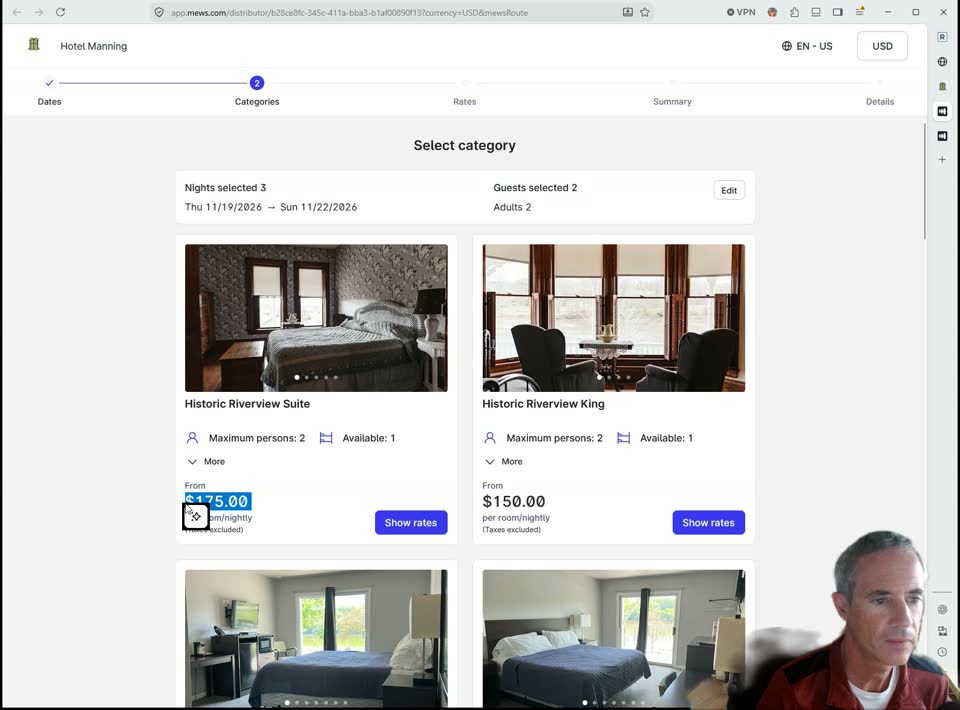
The Mews Categories screen in the walkthrough, at about 1:57. There are prices here, but they are starting nightly rates with taxes excluded.
Show me what I'm going to pay
That brings me to something I feel pretty strongly about: people should be able to understand the price while they're deciding what to book.
In the Mews example, I went through the room and rate selection before reaching the summary where I could see the total with taxes and the selected pet fee. By that point, I'd already made my selections, and I still needed to click Continue to reach the guest details page.
With the ReservationKey setup I demonstrated, the room list and reservation summary are on the same page, so selecting a room brings up the room charge, tax, and total alongside it. You can look at the nightly breakdown and review your selection while the other rooms are still visible. The idea is to keep the price right there as people build their reservation, so they can see what they're committing to as they go.
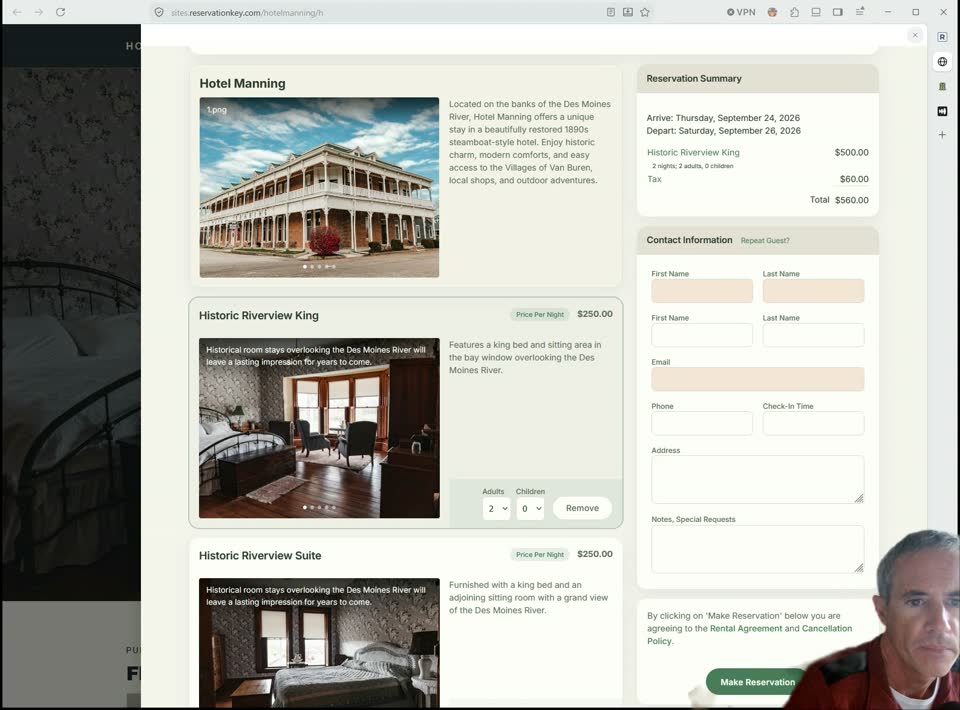
ReservationKey's booking drawer, shown near the start of the video. The selected room, tax, total, and guest information form are together. The two demonstrations use different dates; the dollar amounts are not a room-price comparison.
Want another room? Just add it
Partway through the Mews booking, I tried a very normal situation: our friends are coming with us, so we need another room.
The option I found was called “Add more stays,” although “Add more rooms” would have made more sense to me in this situation. Clicking it took me back from the summary to Categories, where I went through the category and rate selection again for the second room.
In ReservationKey, the available rooms are still right there, so I simply added a double room to the booking. It appeared in the reservation summary with the tax and total updated for both rooms, and I could carry on without going back through the earlier screens.
The whole idea from the beginning was one-page bookings, where you can choose your rooms, review the price, enter your information, and make the reservation in the same place. Adding another room should feel like a natural part of that process.
I hadn't connected a payment method in this demo, so you don't see a card payment being completed. Once a supported provider such as Stripe or Square is configured, guests can also enter their payment information and see the amount due when booking. If you offer optional items, such as a pet fee, those can be configured on the page as well.
Keep the booking right on your website
The same idea carries through to how guests reach the booking page. In the ReservationKey example, they can enter their dates right on the property's website, then click Search to open the booking engine in a drawer over that website with the dates already selected.
From there, they can read descriptions, look through photos, select rooms, and fill in their details without being sent off to a separate tab. I like that continuity because they've come to your website to book with you, and the reservation process feels like part of the site they're already using.
Prefer a calendar? We have that too
Some guests find it easier to look at a calendar and select the nights they want, and ReservationKey supports that approach as well. In the video, I switched to the calendar view and selected three rooms directly on the grid, with the reservation adding up as I made my selections. The rooms don't even have to be booked for the same number of nights, which is useful when people in the same party are arriving or leaving on different days.
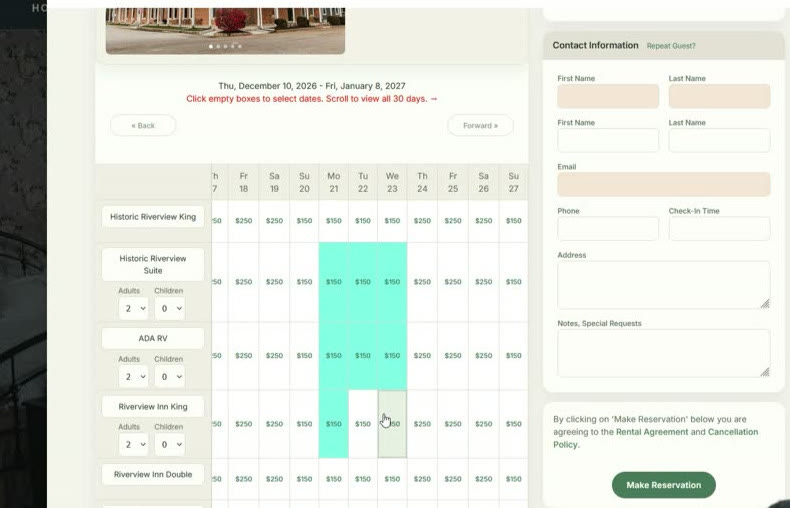
The calendar option at about 7:36: select rooms and nights directly on the grid.
Once the reservation is completed, your calendar updates and confirmation emails go to you and your guest, keeping things straightforward on your side as well.
Make it clear which property they're booking
One other thing caught my attention as I looked through the Mews example: hotel rooms and cabins were listed together, and I couldn't tell whether the cabins were beside the hotel or somewhere else. If my friends were booking a hotel room and I chose a cabin, would we actually be staying near each other? As I said in the video, that booking page may have been configurable differently, but from what I was seeing as a guest, the answer wasn't clear.
In ReservationKey, you can make that distinction clear by setting up separate reservation pages for different properties or groups of units. We created one for the cabins and another for the main hotel, with each website button able to open the appropriate page in the booking drawer. That way, guests can go straight to the accommodation they're interested in and understand which property they're booking.
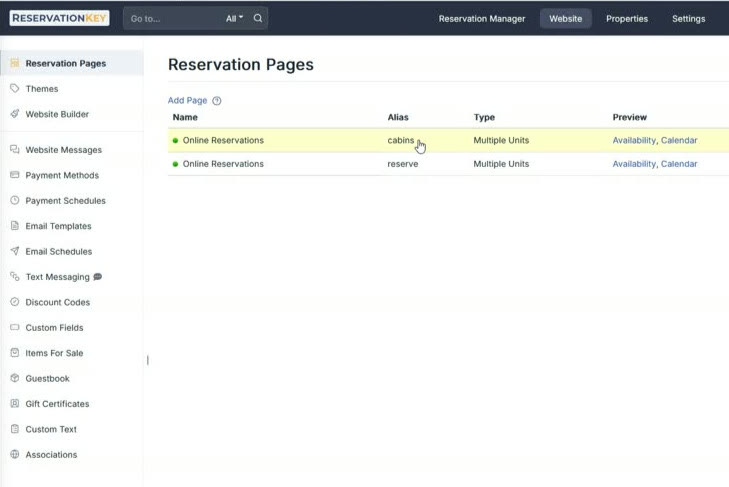
The separate reservation pages shown at about 8:52. You choose which units belong on each page and give guests a clear route to the accommodation they want.
A straightforward system can be economical too
All of this comes back to what the independent properties we work with actually need. They want to manage reservations, take bookings from their website, and get on with running their property, and a straightforward system can do that without stretching the software budget.
Our published monthly software prices start at US$37 for up to four units, US$44 for up to ten units, and US$59 for up to twenty units. The booking engine is included, with no booking commissions or long-term contracts. Optional extras and payment-processing charges are additional.
Since Mews provides pricing tailored to the property, the best comparison is to put your own quote alongside our published pricing for the number of units you manage. I don't have a verified Mews quote for this example, so I can't give you an exact savings figure here.
What I would encourage you to do is look at the tasks you and your guests actually use, because you don't need to assume that a more expensive, more complicated system is what your property needs. If ReservationKey handles those tasks clearly and fits your budget, that's a very practical alternative.
Try making a booking yourself
If you're comparing ReservationKey with Mews, I encourage you to walk through the guest experience yourself. Pick some dates, select a room, check the taxes and total, and then try adding a second room for your friends. As you go, see how easy it is to understand where you are in the process and what happens next.
That's what I did in this video, and it's why I like our approach: everything stays simple and straightforward, even when you want to add another room or change your plans. Your guests already have plenty to think about when planning a trip, so booking the room should be the easy part.
You can start a free 30-day trial and walk through ReservationKey yourself to see how it would work for your property. We'd love to have you try it out.
Based on my September 17, 2026 walkthrough. Public software pricing checked the same day; prices and available options can change.