If your property is listed on Booking.com, Airbnb, Expedia, Vrbo, or other online travel agencies (OTAs), you've probably heard the term channel manager. But what exactly is it, and do you really need one?
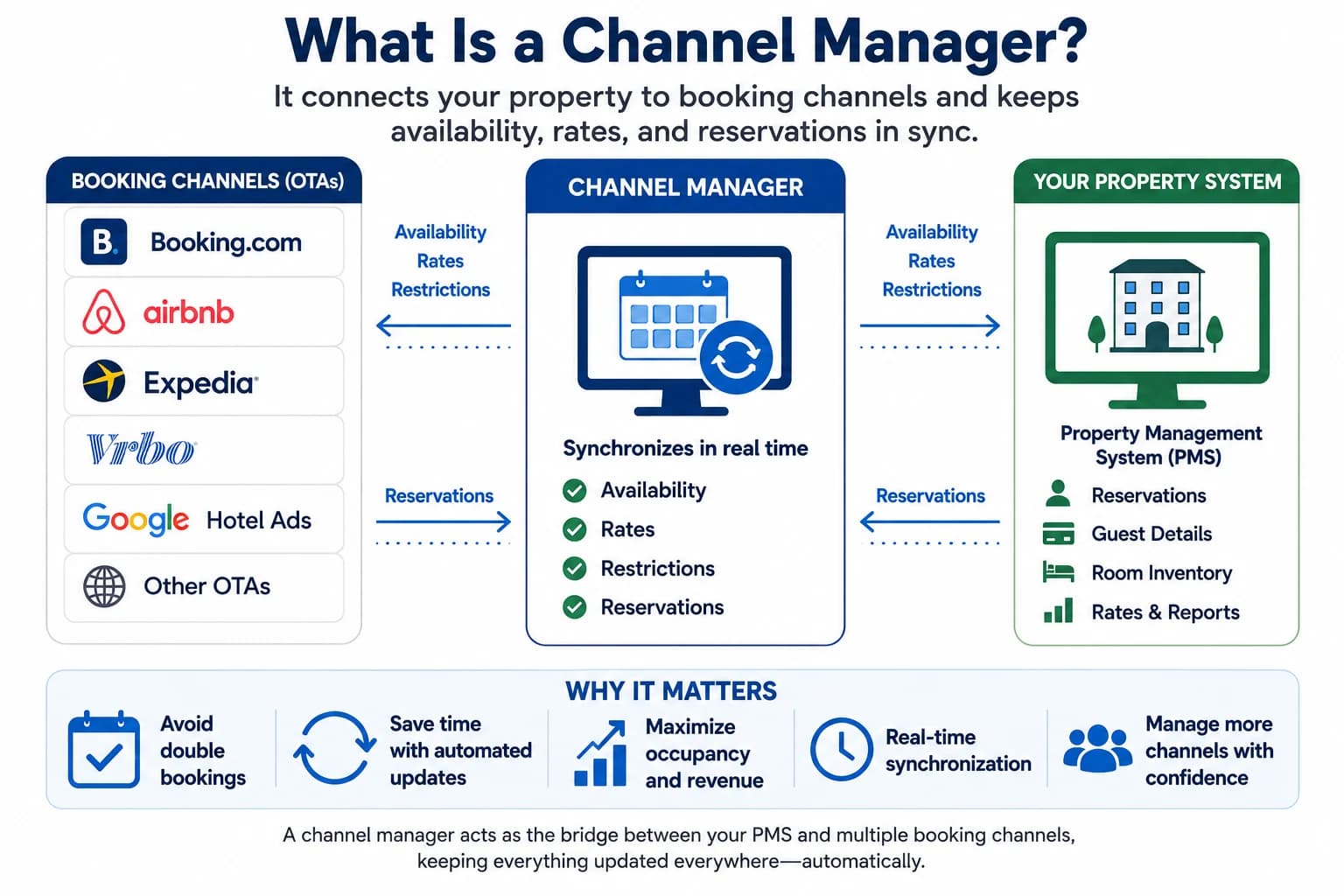
A channel manager is software that automatically synchronizes your property's availability, rates, and reservations across multiple booking channels. Instead of updating every OTA manually whenever a reservation is made or a price changes, a channel manager keeps everything in sync for you.
For hotels, bed & breakfasts, inns, vacation rentals, cabins, campgrounds, RV parks, and marinas, using a channel manager can save hours of work each week while helping prevent one of the biggest problems in hospitality: double bookings.
How Does a Channel Manager Work?
A channel manager acts as a bridge between your Property Management System (PMS) and your online booking channels.
Whenever something changes—such as a new reservation, a room becoming unavailable, or a price update—the channel manager automatically sends those changes to your connected OTAs.
The process is simple:
Guest books on Booking.com → Channel manager receives the reservation → Your PMS is updated automatically → Availability is updated on Airbnb, Expedia, Vrbo, and other connected channels
Instead of logging into multiple booking websites every day, you manage everything from one central system.
Channel Manager vs. PMS
Although they're often used together, a Property Management System (PMS) and a channel manager have different jobs.
Property Management System (PMS)
- Manages reservations
- Stores guest information
- Manages payments
- Handles housekeeping
- Runs reports
Channel Manager
- Synchronizes booking channels
- Updates OTAs
- Sends rates and availability
- Receives OTA reservations
- Prevents double bookings
Think of the PMS as the control center for your property.
The channel manager is the messenger that keeps Booking.com, Airbnb, Expedia, Vrbo, and other booking channels synchronized with your PMS.
Most modern accommodation providers use both together.
What Does a Channel Manager Synchronize?
Most modern hotel channel managers can synchronize:
- Room availability
- Room rates
- Seasonal pricing
- Booking restrictions (such as minimum stays)
- Reservations
- Guest details supplied by the OTA
The exact information depends on the booking channel, as every OTA supports different features.
Why Do Hotels Use a Channel Manager?
Managing one booking website is relatively simple.
Managing four or five booking channels manually is not.
Imagine you have one room left.
A guest books it on Airbnb.
If you don't immediately update Booking.com, Expedia, and Vrbo, another guest could reserve the same room.
Now you have a double booking—a situation that often results in unhappy guests, emergency relocation costs, and negative reviews.
A channel manager helps prevent this by automatically updating your availability across connected channels.
Other benefits include:
- Less manual work
- Faster updates
- Consistent pricing
- Easier reservation management
- Reduced risk of human error
Common Mistakes Property Owners Make
Many accommodation providers assume a channel manager will solve every synchronization problem automatically.
In reality, most issues are caused by configuration rather than the software itself.
Some of the most common mistakes include:
Incorrect room mapping
If rooms aren't mapped correctly between your PMS and the OTA, reservations may import into the wrong room or availability may not update correctly.
OTA promotions changing prices
Many OTAs apply their own discounts, promotions, or rate plans, which can make prices appear different even when your PMS is sending the correct rate.
Relying only on calendar synchronization
Some properties connect channels using iCal calendars. While useful for basic availability updates, iCal doesn't synchronize rates, restrictions, or many reservation details.
These situations often lead property owners to believe the channel manager has stopped working when the real issue lies elsewhere.
How to Choose the Right Channel Manager
When comparing channel manager software, consider whether it supports:
- The booking channels you use.
- Near real-time synchronization.
- Automatic reservation imports.
- Rate and availability updates.
- Reliable customer support.
- Easy room mapping.
- Integration with your PMS.
The right channel manager should simplify your daily operations—not create additional work.
If You're Using ReservationKey...
The advice above applies regardless of which reservation software you use.
If you're using ReservationKey, you can connect to Booking.com, Airbnb, Expedia, Vrbo, and many other OTAs through the Channex channel manager.
ReservationKey remains your central place to manage reservations, rates, and availability, while Channex distributes supported updates automatically to your connected booking channels.
This allows you to:
- Reduce manual updates.
- Keep availability synchronized.
- Help prevent double bookings.
- Manage reservations from one dashboard.
- Connect to multiple booking channels without maintaining each one separately.
Frequently Asked Questions
Is a channel manager the same as a Property Management System (PMS)?
No.
A PMS manages your property's daily operations, reservations, guests, payments, and reporting. A channel manager synchronizes information between your PMS and your online booking channels.
Can I use Booking.com without a channel manager?
Yes.
Many small properties start this way. However, once you list your property on multiple OTAs, updating everything manually becomes more time-consuming and increases the risk of double bookings.
What's the difference between a channel manager and iCal?
An iCal connection mainly synchronizes calendar availability.
A channel manager can also synchronize rates, reservations, booking restrictions, and other supported information, making it a more complete solution for properties listed on multiple booking websites.
Related Articles
Continue learning with these practical guides.
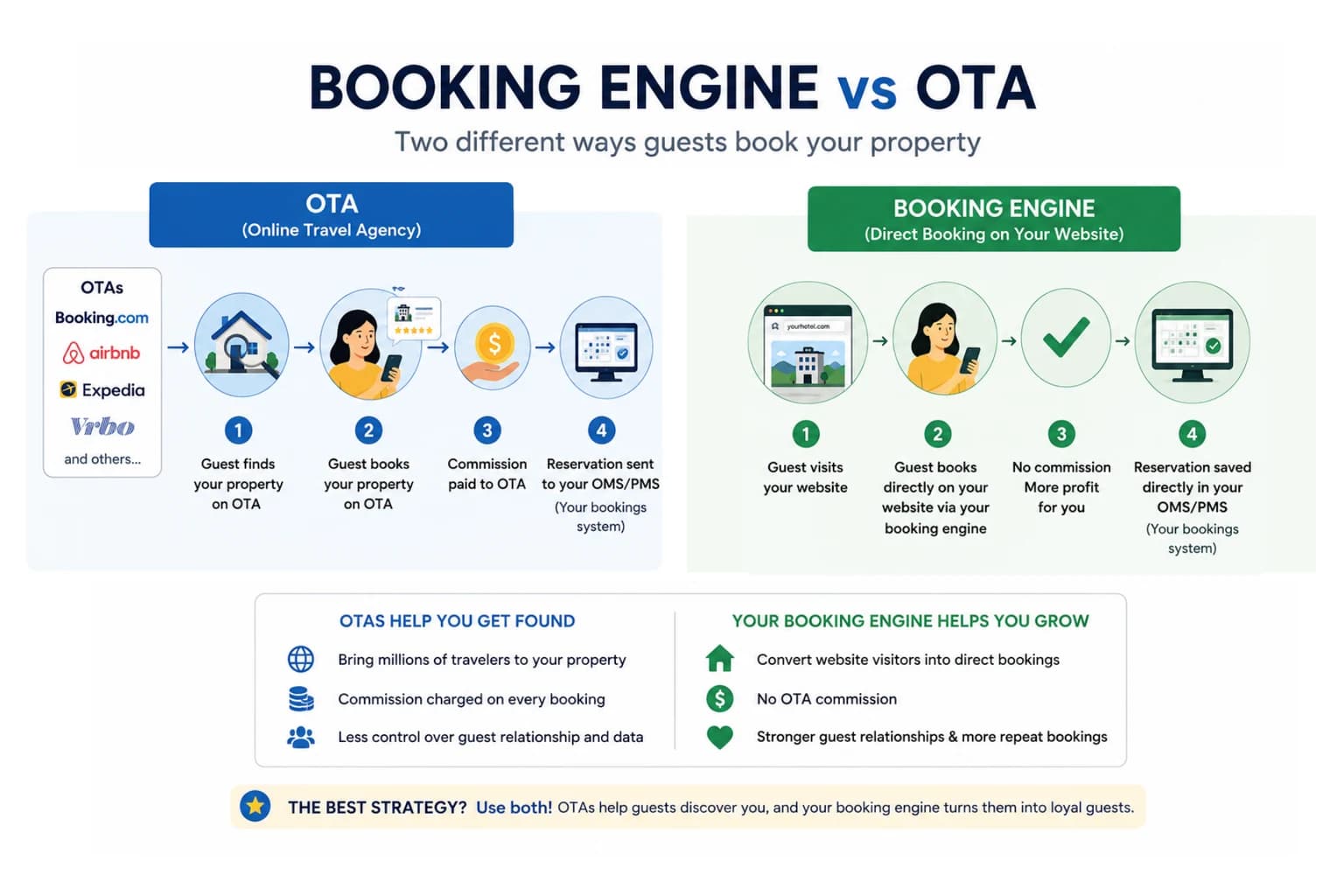
Booking Engine vs. OTA: What's the Difference? (And Why Most Properties Need Both)
Learn the difference between a booking engine and an OTA, their pros and cons, and why using both can help hotels increase direct bookings and reduce commissions.
Read article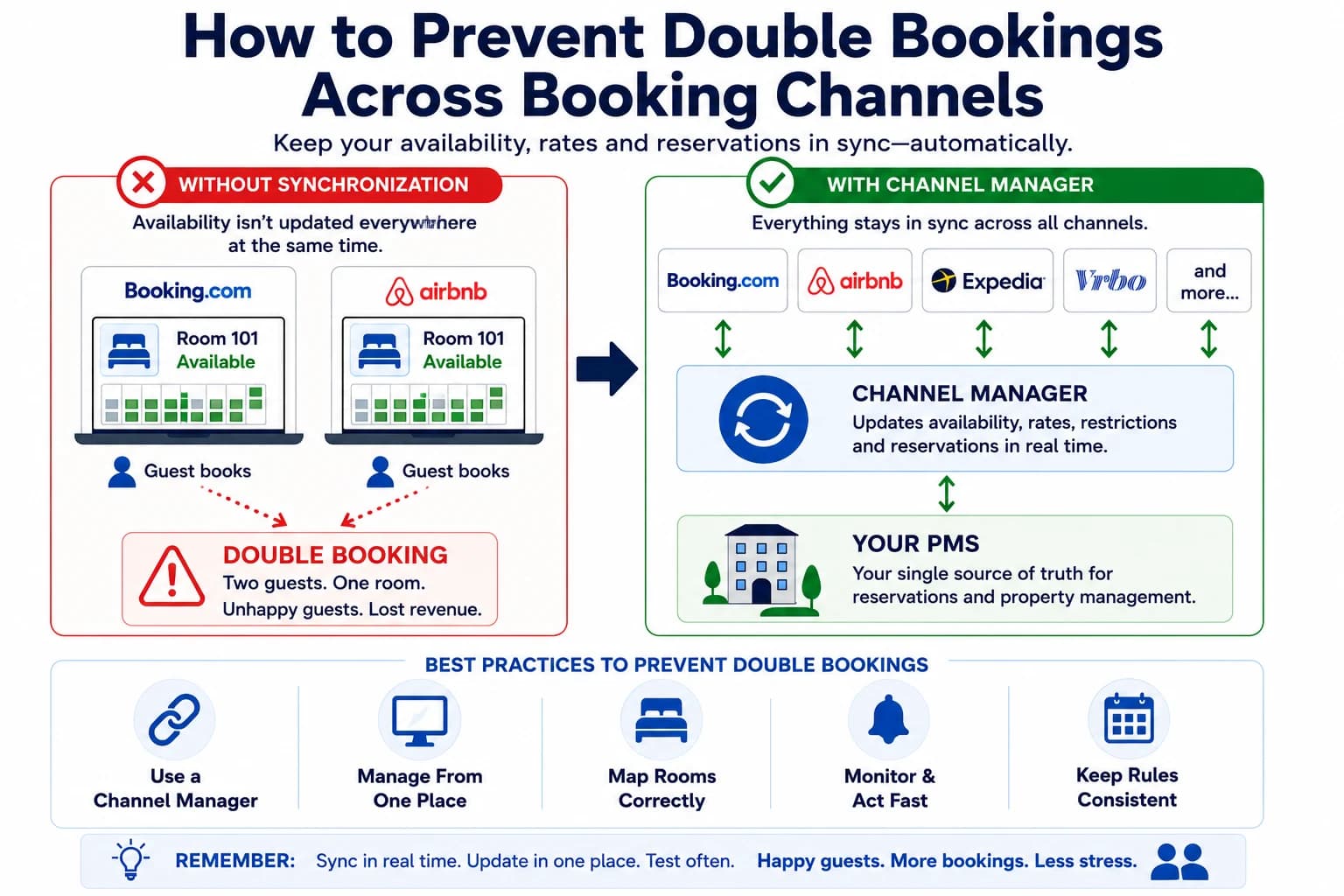
How to Prevent Double Bookings Across Booking Channels
Learn how to prevent double bookings across Booking.com, Airbnb, Expedia, Vrbo, and your website. Discover the most common causes and practical solutions for hotels and vacation rentals.
Read article