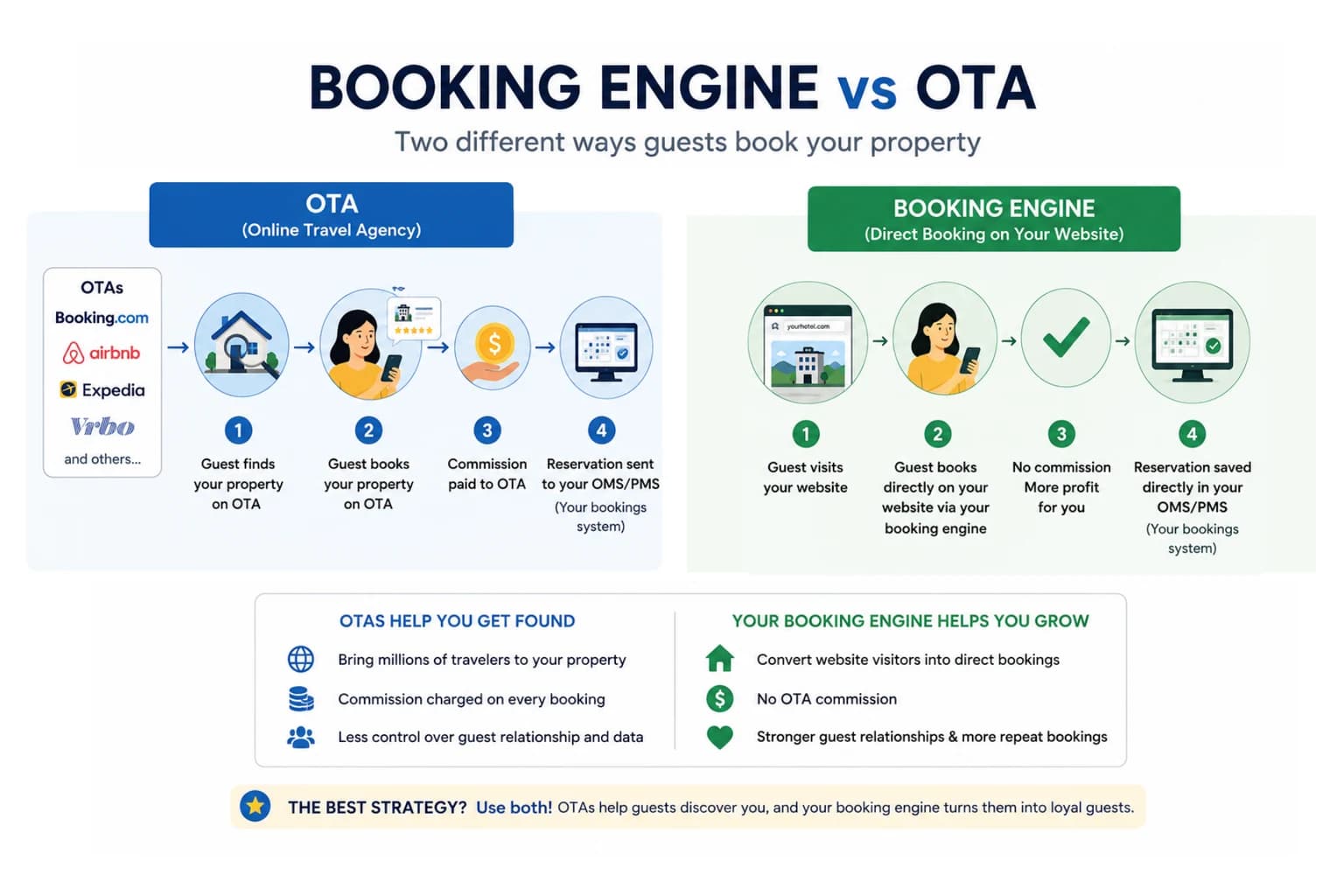
If you're researching ways to accept online reservations, you've probably come across the terms booking engine and OTA (Online Travel Agency). While both allow guests to book your property online, they serve very different purposes.
A booking engine lets guests book directly through your own website. An OTA, such as Booking.com, Airbnb, Expedia, or Vrbo, promotes your property to travelers searching for accommodation and charges a commission for each reservation.
The best strategy for most hotels, B&Bs, vacation rentals, cabins, campgrounds, and other lodging businesses isn't choosing one or the other—it's understanding how each fits into your overall booking strategy.
Understanding the Difference
Think of an OTA as a shopping mall and your booking engine as your own store.
An OTA brings millions of travelers together in one place, making it easier for guests to discover your property. In return, the OTA earns a commission whenever a booking is made.
A booking engine works differently. It's installed on your website and allows visitors to check availability, compare room options, and make a reservation without leaving your site.
Here's a simple comparison:
Both tools play an important role, but they solve different problems.
Why OTAs Are Important
OTAs have become one of the largest sources of online travel bookings because they invest heavily in advertising and attract millions of travelers every day.
Benefits include:
- Increased online visibility
- Access to travelers who may not know your property
- Built-in marketing
- Guest reviews that build credibility
- Higher occupancy, especially for newer properties
However, these benefits come with trade-offs.
Most OTAs charge commission on every reservation, which can significantly reduce your profit margins over time.
Why a Booking Engine Matters
A booking engine gives guests another option: booking directly with you.
When someone finds your property through Google, social media, or a previous visit, your booking engine lets them reserve a room without going through an OTA.
Benefits include:
- No OTA commission on direct bookings
- Greater control over pricing and promotions
- Stronger guest relationships
- Easier communication before arrival
- More opportunities for repeat business
For many accommodation providers, increasing direct bookings is one of the most effective ways to improve profitability.
Common Mistakes Property Owners Make
Many property owners assume they need to choose between a booking engine and an OTA.
In reality, the two work best together.
Some of the most common mistakes include:
Relying only on OTAs
While OTAs can generate excellent visibility, paying commission on every reservation can become expensive.
Using a booking engine without promoting your website
A booking engine doesn't bring visitors by itself. Your website still needs traffic from search engines, social media, advertising, or repeat guests.
Displaying inconsistent pricing
Different prices across your website and OTAs can confuse guests and reduce trust.
Ignoring repeat guests
Many guests who first discover your property through an OTA are happy to book directly next time if you make the process easy.
How to Find the Right Balance
For most independent properties, the goal isn't to replace OTAs.
Instead, it's to gradually increase the percentage of direct bookings while continuing to benefit from OTA exposure.
Some practical strategies include:
- Keep your website updated.
- Make your "Book Now" button easy to find.
- Offer a small benefit for booking direct, such as flexible cancellation or a welcome drink.
- Build an email list to encourage repeat bookings.
- Keep rates and availability synchronized across all booking channels.
A healthy mix of OTA and direct bookings often provides the best balance between occupancy and profitability.
If You're Using ReservationKey...
The general principles above apply regardless of which reservation software you use.
If you're using ReservationKey, you don't have to choose between direct bookings and OTAs.
ReservationKey includes a built-in booking engine for your website and can also connect to Booking.com, Airbnb, Expedia, Vrbo, and many other booking channels through a channel manager.
This allows you to:
- Accept commission-free direct bookings.
- Keep rates and availability synchronized across booking channels.
- Manage reservations from one place.
- Reduce manual updates.
- Encourage repeat guests to book directly in the future.
Rather than replacing OTAs, ReservationKey helps you use them more efficiently while growing your direct booking business.
Frequently Asked Questions
Can I run my property using only OTAs?
Yes, but you'll pay commission on every booking and have less control over your guest relationships. Most successful properties also encourage direct bookings through their own website.
Do I need a booking engine if I already use Booking.com?
Yes. A booking engine gives guests a way to book directly, helping you reduce commission costs and increase repeat business.
Which is better for a small hotel or B&B?
Neither is better on its own. OTAs are excellent for attracting new guests, while a booking engine helps convert website visitors and repeat guests into direct bookings. Using both is usually the most effective strategy.
Related Articles
Continue learning with these practical guides.
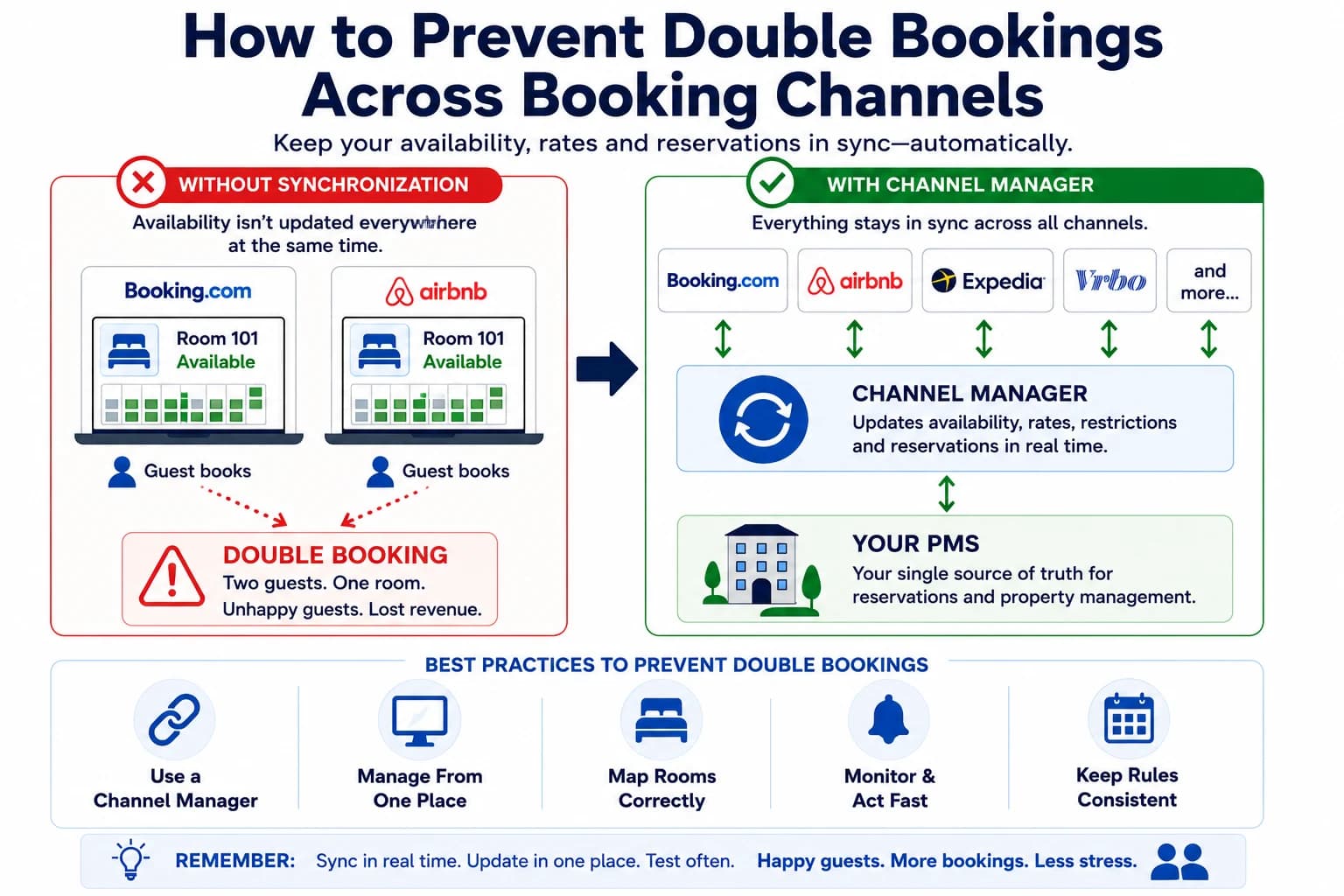
How to Prevent Double Bookings Across Booking Channels
Learn how to prevent double bookings across Booking.com, Airbnb, Expedia, Vrbo, and your website. Discover the most common causes and practical solutions for hotels and vacation rentals.
Read article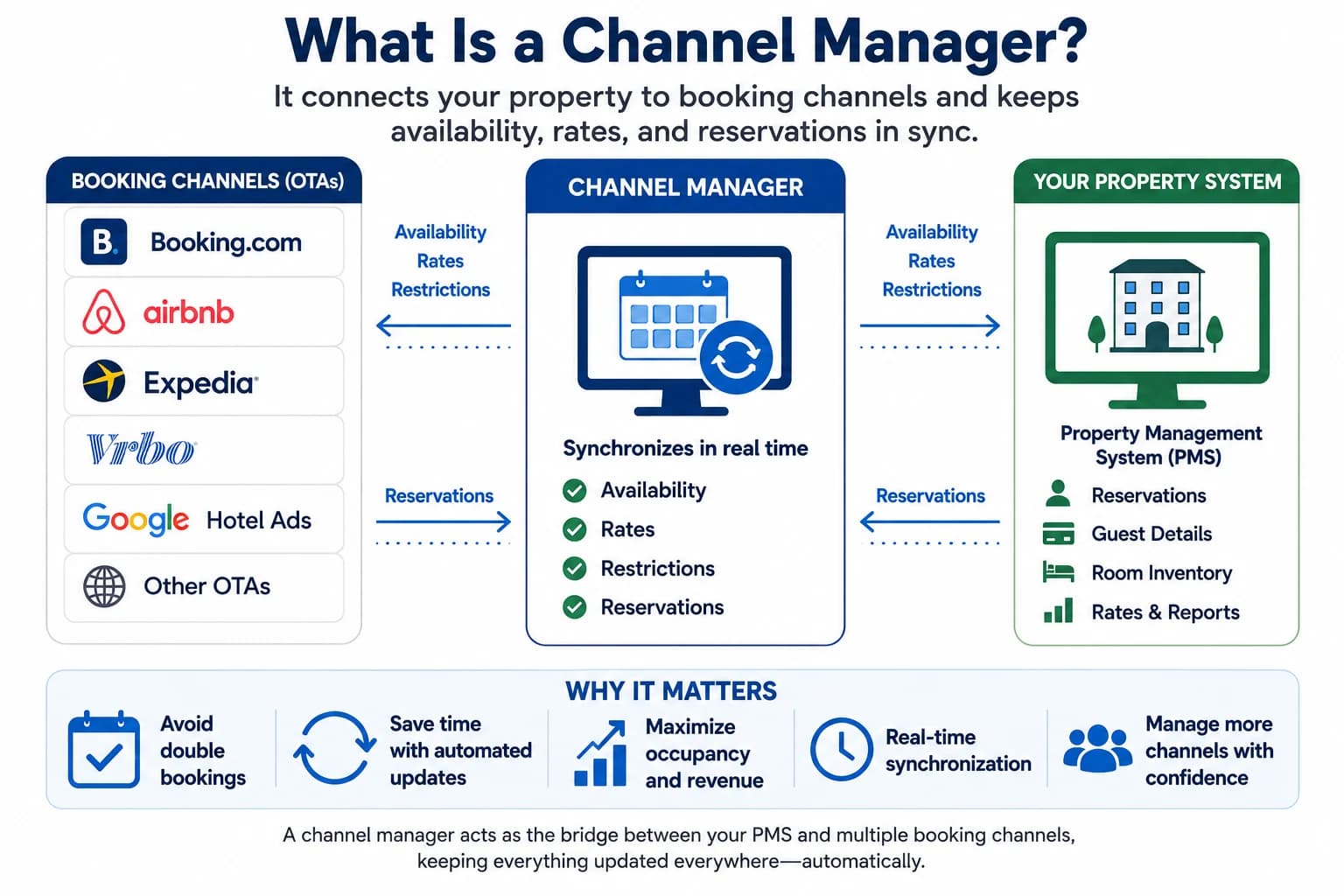
What Is a Channel Manager? (And Do You Really Need One?)
Learn what a hotel channel manager is, how it works, and why it helps hotels, B&Bs, vacation rentals, and campgrounds prevent double bookings and save time.
Read article